
OXYSORB – PREMIUM OXYGEN ABSORBERS


Difference between an oxygen absorber and oxygen scavenger?
Two words for the same thing.
Small devices/ packets/ satchels that are added to food/pharmaceutical packaging. They help to keep the food fresh.
Oxygen absorbers are sometimes confused with silica gel desiccants.
They modify the atmosphere in the packaging environment (i.e. remove Oxygen), and the letter keeping food dry.
This leads to improvement of product safety and shelf life extension. An extensive review has been written by Cichello 2015.
Most oxygen absorbers are the ferrous [iron] type. A wide array of applications, varying in absorption efficiency and speed.
What is inside an oxygen absorber?
Mostly, hydrated metal carbonate i.e. ferrous [iron] carbonate or calcium carbonate, desiccant [activated carbon; for water adsorption sites], salt as a catalyst and some moisture.
Some innovative patents propose the re-use as a soil fertiliser/ conditioner, as well as being biodegradable in part or full;
The first patent for an oxygen scavenger used an alkaline solution of pyrogallic acid in an air-tight vessel, and also the use of ascorbic acid by the British military in food rations in the 1930’s.
Mode of Action
When an oxygen absorber is removed from its low-oxygen-transmission master packaging, atmospheric moisture begins to adsorb onto the activated carbon and interact with the iron particles inside the sachet. This activates oxidation, converting iron into iron oxide. At around 65% relative humidity, and with salt acting as a catalyst at lower humidities, oxygen levels in the surrounding sealed atmosphere can fall below 0.01%. Approximately 1 g of iron can absorb about 300 mL of oxygen.
Oxygen absorber capacities commonly range from 20 cc, 50 cc, 100 cc, 200 cc, 300 cc, 400 cc, 500 cc, 1000 cc and up to 2000 cc. Because oxygen absorbers contain residual moisture and reactive iron, they begin working as soon as the packet is exposed to air.
Most commercial oxygen absorbers are iron-based because iron is cheap, effective and readily oxidised. Non-ferrous scavengers also exist, including systems based on ascorbic acid, zinc, manganese, boron and other compounds, but these are generally more expensive.
The key benefits of oxygen absorbers include reducing oxidation, preserving flavour in coffee, nuts, spices and seasonings, protecting vitamins A, C and E, extending pharmaceutical shelf life, inhibiting mould growth in bread, beef jerky and cheese, reducing browning in fruit and vegetables, and controlling insects or weevils in museum, storage and gallery environments through oxygen deprivation.
Facebook page; Oxygen Absorber Australia.
The benefits of oxygen scavengers include;
– The removal of oxygen, leading to less oxidation of flavour compounds in foods i.e., retaining the fresh-roasted flavour of coffee and nuts, prevents the oxidation of spice oleoresins present in spices themselves and in seasoned foods
– Prevents oxidation of vitamins A, C and E, extends the life of pharmaceuticals
– Inhibits mould growth in breads, beef jerky, cheeses, reducing non-enzymatic browning of fruit and vegetables,
– Killing insects and weevils in a museum/ art gallery environment (oxygen deprivation)
– Oxygen scavenging technology can quickly reduce oxygen levels in sealed containers to below 0.01%.
4Fe + 3O2 + 6H2O —> 4Fe(OH)3
Figure 1. Chemical reaction of ferrous-based oxygen absorber (rusting process)
For a video of the correct SOP to open oxygen and silica gel desiccant bags, please see below;
| https://www.youtube.com/embed/qUO9-s-Swvg | https://www.youtube.com/embed/h2PZCDWglhU |
OxySorb oxygen absorbers are packed with an oxygen indicator. The indicator may contain methylthionine chloride, also known as methylene blue, at less than 1%, and Rhodamine dye at less than 1%. It changes from pink to blue when exposed to oxygen and atmospheric moisture.
Foods with an available water activity below 0.6 may not require an oxygen absorber if hermetically sealed and packed in a container with an oxygen transmission rate below 1 cc/m²/24 hours under ambient conditions.
Correct oxygen absorber sizing should be confirmed with a technical specialist, as more than 10 factors can affect residual oxygen, product stability and shelf life.
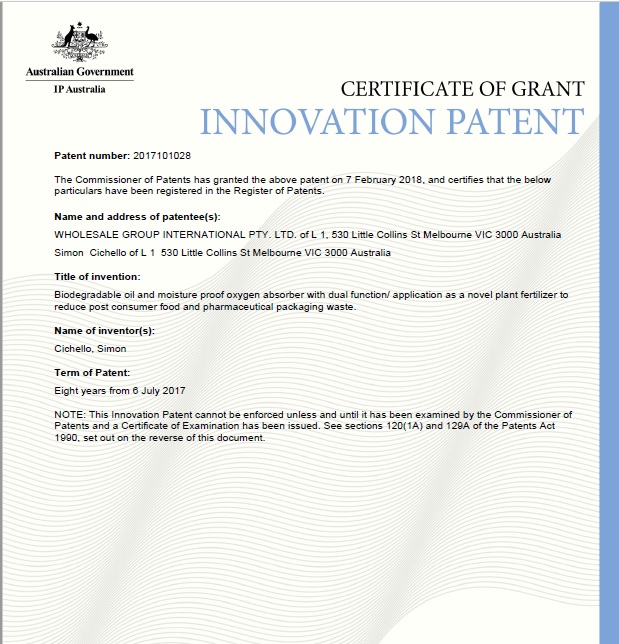
Contrary to common belief, OxySorb oxygen absorbers may also be reused as a soil fertiliser. This application is described in a patent registered by Wholesale Group International Pty Ltd, IP Australia Patent Number 2017101028.
Summary
Oxygen absorber absorb oxygen. They can be in a powdered form added to film, or food i.e. ascorbic acid (vitamin C) (Dave et. al. 1997). They are sometimes also called ‘Oxygen Scavengers’, ‘oxygen absorber packets’, ‘o2 absorbers’, ‘oxygen packs’, ‘oxygen removers’. Primarily, oxygen absorbers are used for food storage i.e. fresh fruit and vegetables (Charles et. al. 2003), walnuts (Jensen et. al. 2003), raw almond kernels (Mexis & Kontominas 2010)& fruit colour stabilizer (Tarr & Clingeleffer 2005), with CO2 aborbers in strawberries (Aday et. al. 2011; Kartel et. al. 2012) but also for use with pharmaceutical products and also equipment storage as well. Extensive literature reviews regarding oxygen absorbers and active packaging have been written by Miltz & Perry 2004, Han 2005, Rooney 2005, Kadoya 2012, Tian et. al. 2013, Realini & Marcos 2014 & Cichello 2015. They can be placed in high oxygen barrier containers i.e. HDPE tubs or packaging i.e. PVdC coated PET/ or Nylon. A popular choice is mylar bags which are commonly used in food storage. Mylar food storage bags are used by the military but also those preparing for food shortage which is a normal occurance in nature and also human civilisation due to war, faminie and pestilance.
Some common brands include OxySorb (Wholesale Group International), Ageless (Mitsubishi), which are food grade oxygen absorbers; HACCP and USFDA compliant and so forth. Often, oxygen absorbers are used in combination with moisture absorbing packets such as silica gel or silica/ clay gel desiccants. They are not ‘deoxidizers’. They can be combined with ethanol emitters (Latou et. al. 2010) in sliced wheat bread preservation, gluten free bread (Gutiérrez et. al. 2011), combined witrh rosemary oil extract in rainbow trout fillets (Mexis et. al. 2009), Greek cod paste (Mexis et. al. 2009), catfish steaks (Mohan et. al. 2006), chicken meat and citrus extract (Mexis et. al. 2012)and modified atmosphere packing with pork sausages (Martínez et. al. 2006), chocolate (Mexis et. al. 2010), milk powder (Thomsen et. al. 2005), with Kerry et. al. 2006reviewing applications in meat, and Tian et. al. 2013 lipid oxidation.
We also supply the oxygen absorber dispensers as well.
If you need an MSDS or other information feel free to contact us directly; [email protected]
Thanks for reading!
| https://www.youtube.com/embed/thNJPNi31mM | https://www.youtube.com/embed/uCYuRSGSRAc |
| https://www.youtube.com/embed/OZsTAKUIT3w | https://www.youtube.com/embed/6t29TNk7ecY |
OxySorb is the world’s first 97% biodegradable oxygen absorber using Blockchain based technology for traceability.
NutriBlock; a blockchain technology for agri-food traceability.
Click Here for the Patent.
It is a B 2 B private ledger system.
You can trace all of our batches and know when and where the oxygen absorbers were made, shipped, warehoused, dispatched, tested in laboratories.
We are happy to release the beta version to clients of Wholesale Group International and invite you too to join the Blockchain with us.